Wednesday, July 8, 2009

Meeting Instructional Design

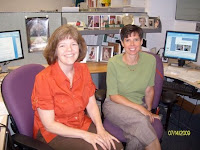
Today I met with Lei, the instructional designer for the library. As a designer he manages audio engineering, screen capturing programs, setting up tutorials online, producing videos for classes online, and teaches others how to connect to the Internet and to the programs he manages online. To do the videos as classes he works with Jan who gives him the script, all the writing part of the class, so that Lei can record it and put as a video online. He enjoys his job because he makes resources more available online, he can serve as a consultant for questions about the library or online sources, he's getting to do something he likes, he can express his creativity, and by the script that Jan gives him he can learn in the process of creating the video. You can actually see a video at http://www.med.yale.edu/library/education/guides/screencasts/finditfast/finditfast_1/ or by going to the Yale medical library website and go to Guides and Tutorials and click on any video there. Things that he feels could improve is to be able to learn as fast as new technology comes out and easier technology could be created that would allow for him to do his job in a shorter amount of time. For example, right now it takes Lei about 45 days to get a whole session of video classes done. With easier technology he could hopefully get the whole session done in less time.

Meeting with Educational Services (Continue from July 8, 2009)

Today I met Jan who is an educational services librarian. She mainly organizes educational experiences that have to do with the library and teaches about the use of the library. Jan also does 3 hour classes to medical students to get resources for their theses. She has seen that her most busiest time of work is during June, July, and August because of summer programs and the process of new medical students coming to the library. Other programs she is involved in are mentoring new librarians, liaison program with psychology (children's mental health), clinical scholar (people who are physicians who do in depth research on health), and dentistry. She also does systematic reviews on literature for studies and works with the Personal Library Program with Judy to divide around 300-600 students among the reference librarians. Another program that she did that she really enjoyed was a Pilot Program. The director of the library, Kenny, rented her out for three years to where she helped kids to cope with domestic violence and other traumatic events. What she hopes to improve or hopes could be improved is for the improvement of the way younger kids and teens learn, more ways of learning and teaching on an online world, working with search engine producers to help organize the information for easier ways to search information, and that certain information and resources should be organized according to the different age groups. In other words look at the different age groups and adapt the resources to them, like for example younger people should be able to access more online or electronic resources.

Preservation Tour (Continue from July 8, 2009)


After meeting with Claudia Merson, I met with Sarah, who gave me a preservation tour. Her occupations deals with preserving and exhibiting historical items, like books. She works with two other students from Yale, trioging over 140 thousand books. In other words working to fix historical books, from the 13th century to the 19th century, that might have gotten damaged either during travel/transport or aging, by the ones who are the most damage to ones that can last longer without being fixed. Some of the books she has and tries to preserve were made with materials that over time have become deteriorated, like for example books with paper made of wood pulp have deteriorated more than paper made with cotton. Sarah really enjoys her job because she's doing a lot of hands on work and also being a part of preserving historical items and some of the world's finest items in the world, so that others in the future can see and learn about the history of medicine and of science. During the tour I also learned some fun fact like the first paper was made of cotton, then later with wood pulp and also with animal skins, like calves. I also learned that it wasn't until the 1950s or 1960s that women were allowed to come to Yale to work and get an education.

July 8, 2009 (My Second Day)

My second day began with a walk to Claudia Merson's office. Claudia is the director of partnership between Yale University and public schools. She works with school principles, administrators from Yale, and librarians (because they have a lot of information on different topics) to set up different activities for students to expand their knowledge beyond the education they learn in school. She has a partnership with Hill Regional Career High School and COOP where she's been apart of for 10 years and has set up programs like SCHOLAR, tutoring programs, and many other programs, in hope of letting students experience and learn more educational things. Claudia really enjoys her occupation and says "It's the best job in the world" because she loves being able and being a part of giving more opportunities for students and extending and enriching the public school curriculum. What she is most excited about is the SCHOLAR program that is now reaching its 11th year. She loves how this program allows high school students be able to experience how their lives might be during their college years. What I found most interesting about Claudia was that she had first majored in the college of NYU in a theater major and later in Georgia State as an English major and Linguist minor. What also was interesting was that when she was young she wanted to be an actress and she says that when she retires she wants to be a world famous cartoonist.

Meeting with Curriculum Support Librarian (Continue from July 7,2009)

After meeting with Holly and Denise, I met with Judy, a Curriculum Support Librarian. She works with faculty and medical students, in their connection to the library and different soft wares. She manages a black board where she helps teachers put their notes, quizzes and tests online and helps the students be able to see and take them. She is also Liaison with the Basic Science Department of the school of medicine that includes 10 different topics like Biology, Anatomy, etc. She is a person librarian to 600 students who include medical physicians, graduates, and undergraduates. Other soft wares or things that she is managing are Exam Master-online medical testing, Image Collections or Online Software-for faculty and some students to see images of the body, and VH dissection- to be used by 1st year medical students to where they can dissect a human body on the Internet. She also does lechers at the Grand Ground where she talks about the library and how she can help both the students and faculty. What I found interesting was that she also had majored in something different before majoring as a Medical Librarian. She had majored in a Humanity major in English, but after graduating she felt that teaching wasn't really something she wanted to do and after working in a library for some time she decided to get her degree and become a Librarian. She loves working as a medical librarian because she feels that it's never boring because there is always something going on but also because there is a lot of interaction between teachers, students, and herself. She has been working at the library for 13 years and hope to continue to work there in the years to come, but is open to branch out and do more new things while still doing the job she loves. I have learned already so much just on my first day and can't wait to learn more about the other roles that people have that help keep the medical library up and running and accessible to others.

Meeting with Liaison Librarians (Continue from July 7, 2009)

After the tour I met with Holly and Denise. They both are Liaison Librarians, which means that they both work together with other people like physicians, staff, administrators, and patients promoting and marketing the use of resources from the library. Holly also supports OBGYN while Denise supports Psychology, but they both help each one by getting resources for them. What I found interesting was that both of them majored in different studies before getting their degree as Medical Librarians. Holly had majored in English while Denise had majored and got a PHD for American History. Both of them wanted to become teachers, but after getting an opportunity to work at a library, both felt that being a medical librarian was a better option. Through out their years of working in the library, Holly for 8 years and Denise for 4 years, they both have been enjoying and love their occupation, mostly because of its flexibility, because they both have children, and the opportunity that is allowed for trying new things. They both also work as Personal librarians for medical students from Yale, in which they help find resources that they might need. Lastly they both help motivate others to become medical librarians like them.

Tuesday, July 7, 2009

My First Day as a Chili Intern (Tuesday July 7, 2009)

Hello every one, my name is Yezmin Crespo and starting today I will be getting the opportunity to learn more about the medical library, the job opportunities, and much more, as the new C.H.I.L.I intern. My day began with getting to briefly meet some of the staff who work at the library during a CRS meeting. There I also got to hear about proposals to better a program that the library has called Meebo. I learned that through Meebo, people could and are able to go to this site and ask librarians questions on resources they can use for projects or research, live through the Internet. It was very interesting. After the meeting Mr. Greenberg gave me a tour of the medical library, which I found quite fascinating. I couldn't believe how big the library was and how much great information it held. It was truly amazing. During the tour Mr. Greenberg showed me a picture of Mr. Cushing (1869-1939) who was a Founder of the Library and also one of a few surgical neurologist who promoted the use of wearing gloves during a surgery to prevent the contamination and death of patients.