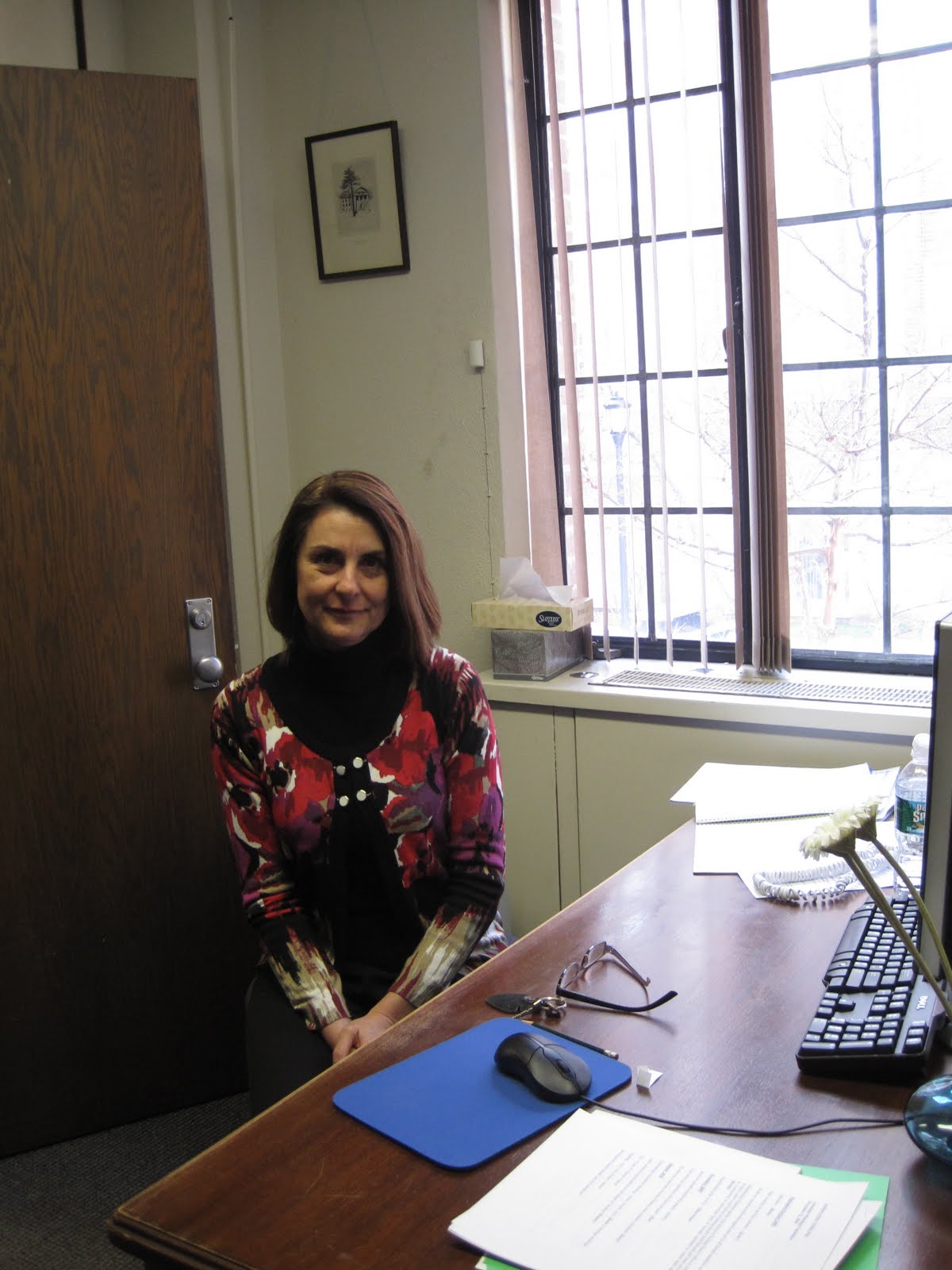
 Today I had the opportunity to meet with Diane Turner. She is the head of the human resources for the Yale Library. She has been working at Yale for 32 years. Most of her job involves hiring people and providing counseling to the ones that are getting laid off. She is also responsible for staff training and human relations. She loves to learn and interact with people. The difference between the Medical library and the other libraries is the fact that they deal with life and death situations. The characteristics needed for her job are: respect, communication skill, and sound judgment. I really enjoy my time with Diane. She is a wonderful person.
YALE MEDICAL LIBRARY

Friday, February 18, 2011
Diane Turner
Today I had the opportunity to meet with Diane Turner. She is the head of the human resources for the Yale Library. She has been working at Yale for 32 years. Most of her job involves hiring people and providing counseling to the ones that are getting laid off. She is also responsible for staff training and human relations. She loves to learn and interact with people. The difference between the Medical library and the other libraries is the fact that they deal with life and death situations. The characteristics needed for her job are: respect, communication skill, and sound judgment. I really enjoy my time with Diane. She is a wonderful person.
Wednesday, February 16, 2011
Day with Denise
 Today I interviewed Denise. She started out getting a masters degree in American History. Because of her lack of interest in teaching, she earned her library degree and started working at Smith college as a librarian for 3 years. She worked at Connecticut College managing a small department for 1 year. Currently she has a job share position, half time. Now she had been working at Yale Medical library for 5 1/2 years. Denise works as a liaison program coordinator. One of the things she does is write monthly Liaison email messages for the other liaison staff to send to the department they are working with. Denise works with the Cancer Center, the Anesthesiology Department, and Comparative Medicine. One thing she loves about her job is the flexibility and the environment. One of the things that she had learned while working here is that it ok to admit when you do not know something. The characteristics needed for her job are: Self confidence and the art of persuasion.
Today I learned that working with people who like you and that you like can really make your job easier.
Tuesday, February 15, 2011
15-feb-2011
 Today I had a demonstration of how the book scanning works. Kelly and Kristen are working on the Medical Heritage Library project, collaborating with other libraries to get rare old books onto the internet so anyone can use them. One reason that this is a great idea is because it helps students and researchers all over the world. They can also use it when they need to. The book scanner has three cameras ( see the Youtube video below). The special thing about the book scanner is automatic but you need someone to make sure the machine is doing all the pages one by one. In a normal day if all the electronics are working properly the staff can probably do 1800 to 2100 pages an hour depending on the condition of the book. If the book is old and not in good condition, it may take longer.
Matt is the
 Medical librarian for the School of Public Health and also the director of technology . As a librarian he makes information available to Public Health students and teaches them how to acquire, organize and apply information to health problems. He deals with the administrative aspect of Academic Technology. Throughout the years he had spent working at Yale, Matt has learned a little bit of everything. He believe that librarians are the bridge that connect patients to health providers.
Monday, February 14, 2011
Meeting with Janene Batten
 Today I Interviewed Janene Batten, she went to Southern Connecticut State University. After earning her degree she worked for 3 years at a hospital library. When I asked her how the hospital library was different, she told me it was not that different but the hospital library was inside of a hospital. She later started working at Yale Medical library. She is the Nursing Librarian for the School of Nursing and currently supervising the Medical Historical Library. As a nursing librarian she works with students, teaching them how to find information and she also worked closely with nursing faculty on the Curriculum Committee.
Since November, as the acting Historical Medical librarian, Janene finds information, answers question and works in the administration. She enjoys learning about Harvey Cushing , the father of neurosurgery.
Today I learned that they are many careers within one career. I also learned that sometimes knowing history can help you to understand the modern world.

An old book from the Historical Medical Library.
Friday, February 11, 2011
Afternoon with Jan and Lei
 Jan Glover work at the Medical Center in Portland, Maine for 11 years. Then came to work at Yale. She been working there for 23 years. She is the only person so far that I interviewed who decided in high school that she wanted to become a librarian. She went to University of Rhode Island to get her MLS. Jan is a typical public services librarian: her job is to educate new students and staff about the resources of the library. She also works on systematic reviews, when a group of scientists evaluate the accuracy of many research results. Jan really like her job because it teaches her a lot about medicine. One of the things she is doing now is creating a tour for the Cushing Center, and she is surprises about of how much she is learning about brains.
Moments later I  chatted with Lei Wang. One of the things I like about Lei was how passionate he is about his job. He is a instructional design librarian. He translates tasks such as accessing library information online into short movies, making them available to everyone. He is also a library liaison for neuroscience and making sure they receive the information they need. One of the coolest things about Lei's father is that he has a library at home in China with more than 10 thousand books, including his own online catalog, to make it easier for him to find books. To be a Instructional design librarian you need to have curiosity, to have the courage to try new things, and have good customer services skills.
 chatted with Lei Wang. One of the things I like about Lei was how passionate he is about his job. He is a instructional design librarian. He translates tasks such as accessing library information online into short movies, making them available to everyone. He is also a library liaison for neuroscience and making sure they receive the information they need. One of the coolest things about Lei's father is that he has a library at home in China with more than 10 thousand books, including his own online catalog, to make it easier for him to find books. To be a Instructional design librarian you need to have curiosity, to have the courage to try new things, and have good customer services skills.
Thursday, February 10, 2011
Afternoon with Regina and Lynn
 Today I interviewed the Yale Medical Library director Mrs. Regina K. Marone. She had been working at Yale for 32 years. After high school she worked for a phone company for 5 years. Then she went to SCSU, where she majored in Library Science. As a library director she gives advice,writes reports, and works with the Yale donors. To work as a medical director you need to have a good sense of curiosity, have good communication skills and also like to work with people.
Later tha
 t afternoon I also interviewed Lynn Sette, a reference librarian. Lynn teaches classes and does marketing and liaison activities. She teaches classes to staff and students to make sure they are aware of the library resources. For marketing she organizes events, makes brochures, sends email and online invitations to the students for the events that are being held at the library. In her liaison responsibility she works with two departments: Dermatology and Pediatrics. She sents them information about new library offferings, such as new journals, books and articles that are publish in their fields.
Today I learned that creativity is sometimes required in a profession. Also, always try to make a difference in the world whenever it is possible. Lastly I learned that as a woman make sure you can take care of yourself so you do not have to depend on a man. Becoming a professional with a career can help with that.
Wednesday, February 9, 2011
Afternoon with John Gallagher
 I spent the afternoon with John.He is the deputy director for the Medical library. He said when he started working as an evening supervisor for the library, he only worked with books. Now he works with books and electronic library resources.
The Yale Medical library has about 9,000 journals and millions of articles on library user computers. To find these articles or journals, an electronic index like Pubmed and Scopus is being used. If the library does not have an article or journal, an Interlibrary loan staff would help find it.
Vermetha, on
 e of the Interlibrary loan staff, would use a national catalog of library holdings like docline and OCLC to find it. This is very similar to any kind of library. If someone is looking for a book at a local library and does not find it, the librarian will look at other libraries to find the book that the person is looking for and borrow it. Vermetha stated that when she started working at Yale 14 years ago, she sent all the requested articles via mail; today she sends them through Email. This demonstrates that technology spreads information quicker and faster.
Today I learned that a library is supposed to be a quiet and inspiring place.I also learned that medical librarians have a role in patient care and research. The big problem regarding medical librarianship is lack of recognition for important tasks that are often invisible.
Subscribe to:
Posts (Atom)